How to Tell if Your Bathroom Subfloor Is Water Damaged
Quick answer
Press on the floor. Soft, spongy, hollow-sounding, or flexing spots near the toilet, tub, and vanity point to a damaged subfloor. A moisture meter reading taken on the subfloor itself, not the baseboard, confirms it. Sound panels can often be dried and kept. Soft or swollen panels are replaced before tile goes down.
Signs Your Bathroom Subfloor Is Water Damaged
Restoration and flooring sources agree on the same handful of signs. Check them in this order:
- Soft or spongy spots. Press firmly along the edges of the room and around the toilet, tub, and vanity. Soft, springy areas often point to rot.
- A floor that flexes or sounds hollow. A floor that gives underfoot or sounds hollow compared with the rest of the room is worth a closer look.
- Movement in the flooring itself. Tile that has cracked or gone loose, grout that keeps cracking, or vinyl that lifts or gaps can all be sitting on a subfloor that is no longer solid.
- Stains and smells. Dark staining, a musty smell, or swollen baseboards near the fixtures mean water has been getting somewhere. Look under baseboards and behind the toilet and vanity.
If the bathroom sits over a basement or crawl space, look at the underside of the floor too. Stains, soft wood, or mold on the joists and the underside of the panels tell you more than the top does.
Dry It or Replace It?
Not every wet subfloor has to come out. What matters is how the panel feels, how it looks once the old flooring is up, and what a meter says. The table shows how the usual cases sort out.
| What you find | What it usually means | What happens next |
|---|---|---|
| Firm panels, no swelling or staining, readings that come down after drying | Water got to the surface but not into the core | Dry it, check it again with the meter, and build the new floor over it |
| A soft spot about the size of a dinner plate in front of the toilet | A local leak | Cut out the bad section and patch it between two joists |
| Spongy, swollen, or delaminated panels, or a long-term leak around a shower or tub | The panels have rotted, and the framing may be affected | Replace the panels, possibly the whole deck, and repair any soft framing |
| Concrete slab under the bathroom | Wood-floor tests do not apply | Moisture vapor or relative humidity testing, and a fix for any excess moisture before tile |
The soft spot and long-term leak examples come from a flooring guide. Every floor is different, and the real answer comes from looking at your floor.
How to Measure a Subfloor for Moisture
- Take readings on the subfloor, not the baseboard. A reading on a baseboard or a surface measures something else. That usually means lifting the flooring or cutting a small inspection opening.
- Use a pin-type meter for a reading you can rely on. Restoration sources say a pinless meter is not conclusive on its own. Read a freshly exposed face of the wood, because the outer surface can read dry while the core is still wet.
- Compare against dry material. The restoration industry's standard (IICRC S500) defines "dry" as a reasonable approximation of that material's normal moisture, which you find by measuring similar, unaffected material in the same home.
- Check again later. The surface dries quickly and the core lags by days, so one reading on day one is not enough.
Why we do not give you one magic percentage
Numbers you find online mostly come from wood-flooring guides. A 2012 Q&A in Journal of Light Construction gives subfloor limits of 11 percent in the northeast, 14 percent in the humid Southeast, and 9 percent in the arid West, with nothing for the Midwest. An APA handout on hardwood installation says under 13 percent. None of those are tile numbers. For tile, the limits that count are the ones the maker of the membrane and the thin-set publishes, so we read them for the products on your floor.
How Long Does a Wet Subfloor Take to Dry?
There is no universal number of days. It depends on how wet the panel got, how thick it is, how much air moves across it, and the weather. The honest way to know is to measure, wait, and measure again, and to take photos of the final readings. We found no tile-specific drying time in any source we trust, so we do not promise one.
What We Did in a Bel Aire Bathroom
The homeowners' vinyl plank floor was letting water through to the subfloor. When the planks came up we checked the panels and found them still in good condition, so we dried the subfloor out and installed a Schluter Ditra membrane over it rather than tearing it out. Replacing sound panels would have added time and cost. The scope, photos, and timeline are on the Bel Aire bathroom tile floor project page.
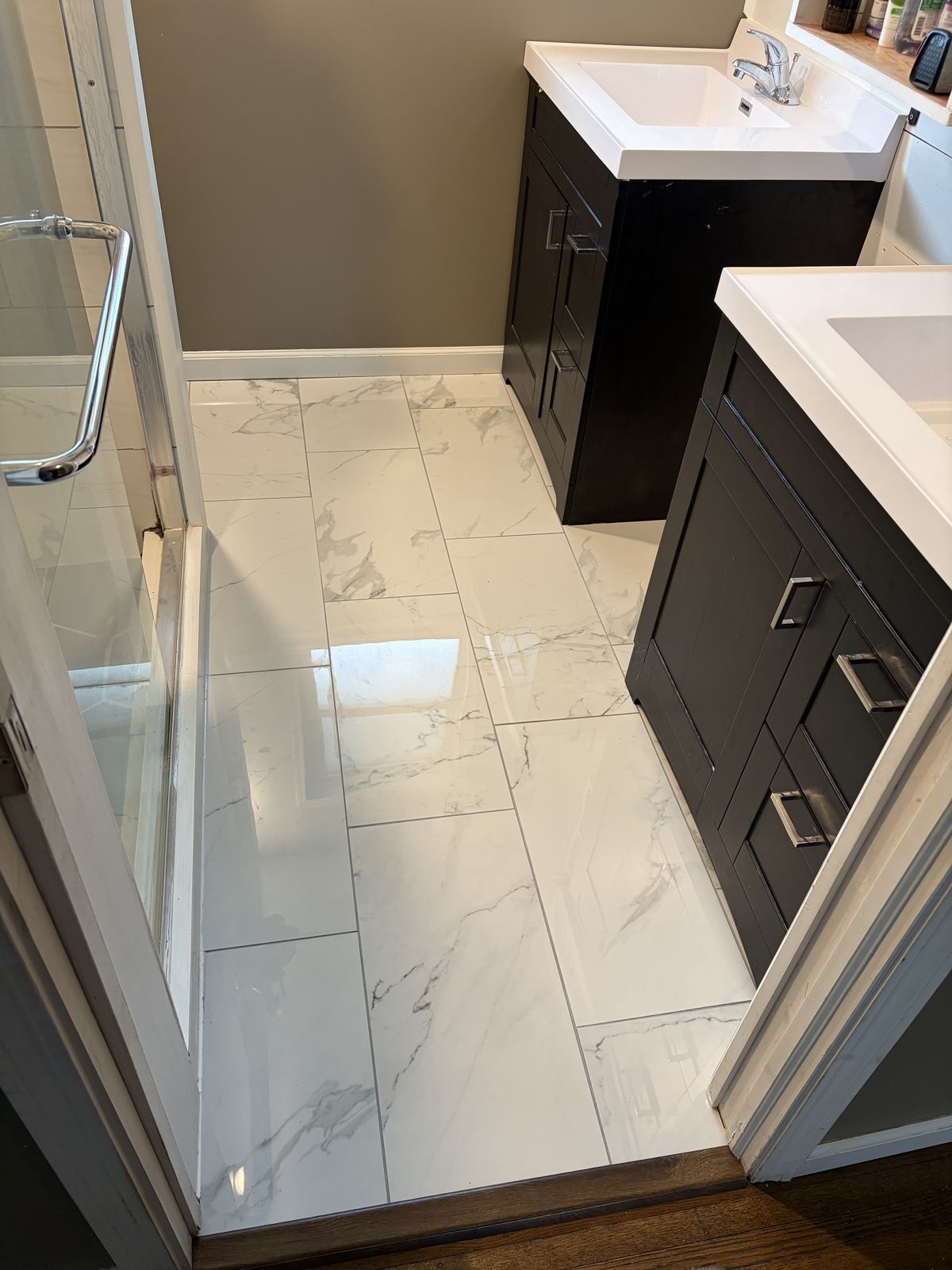
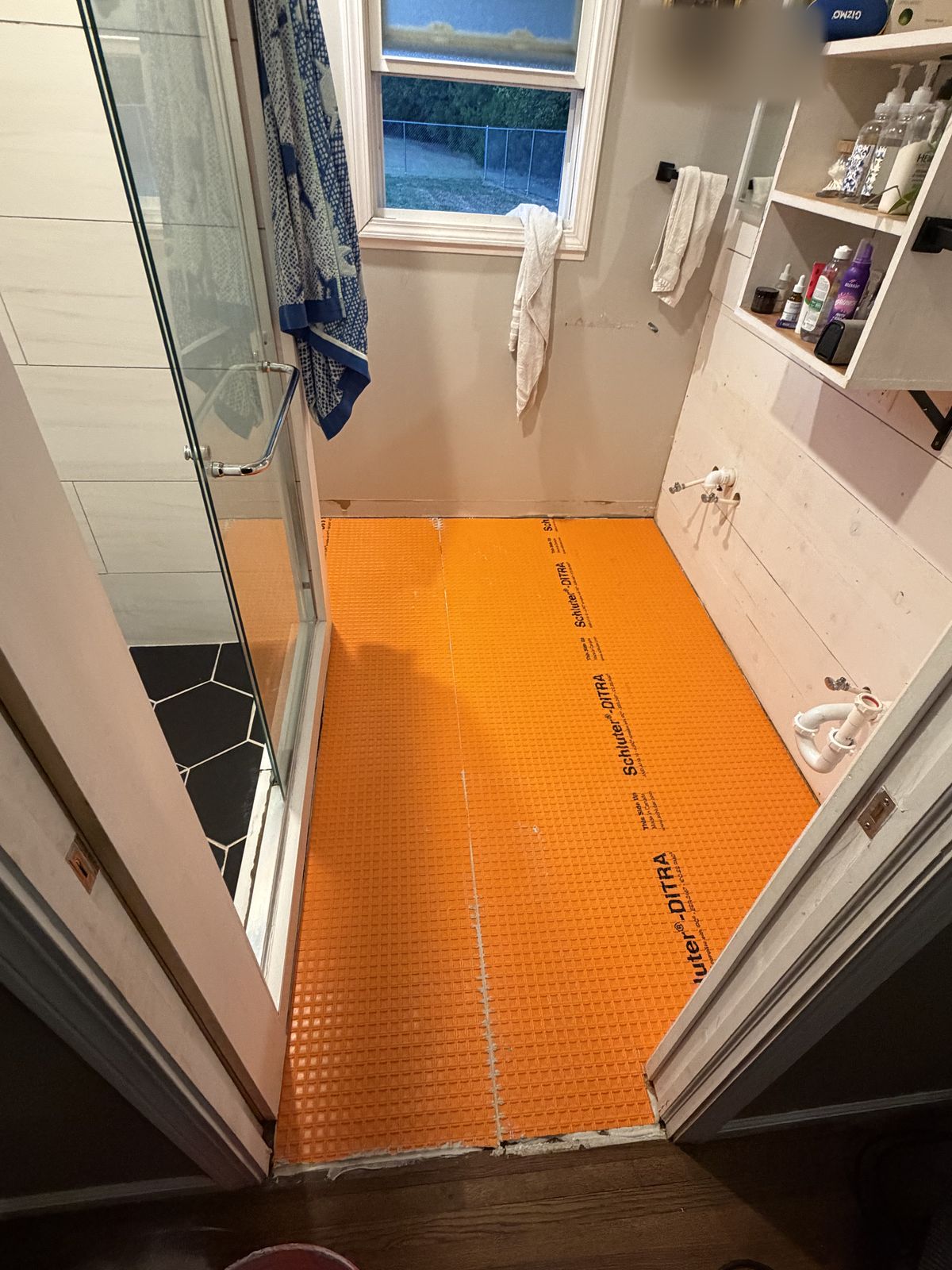
The finished floor, and the membrane going down over the dried subfloor, from the Bel Aire project.
Wichita and Kansas Factors
What is under your bathroom matters
A bathroom over a basement or crawl space, a bathroom on a slab, and a bathroom on a second floor each get checked differently. Wood subfloors are checked from above and often from below. A slab gets a moisture test. Tell us which you have when you call.
Kansas soils and slab floors
The Kansas Geological Survey notes that some Kansas soils contain montmorillonitic clays, which shrink and swell as they get wet and dry out. Its table covers Kansas soils statewide, so it does not say whether the soil under your house is one of them. The free USDA Web Soil Survey shows the soil series at your address. If a slab under a bathroom is cracking or moving, no flooring layer fixes that, and it is worth having the cause looked at before you tile.
Older floors, older leaks
Wichita's median home dates to 1974 and Bel Aire's to 1995, according to City-Stats and 2023 Census survey figures. Older homes have had more years for slow leaks to build up at toilet seals and under vanities, so it pays to look under the old floor before covering it.
Replacing subfloor and permits
MABCD says finish work such as tile can be replaced without a permit. Cutting out and replacing structural panels or framing is a different question, and Bel Aire runs its own permits. Call MABCD at (316) 660-1840 or Bel Aire Planning and Zoning at (316) 744-2451 ext. 121 before you start, and see our remodeling permits guide. TC Carpentry & Construction pulls the permit when a project needs one.
We check the subfloor as soon as the old floor comes up
A moisture meter, a screwdriver pressed into the panels, and a close look at the framing tell us what we are working with. If the subfloor is sound, we dry it and build over it, the way we did in Bel Aire. If it is not, we show you and quote the repair as its own line item.
Bathroom Subfloor FAQs
Can you tile over a water-damaged subfloor?
Not over a soft, swollen, or rotted one. Soft panels have to be repaired or replaced first, and tile needs a firm, flat base. If the panels are still sound and dry after a leak, they can be kept and covered with a membrane, which is what we did on a Bel Aire bathroom.
Can a wet subfloor be dried instead of replaced?
Often, yes, if the panels are firm and not swollen, stained through, or delaminating. Dry it, measure the moisture again, and compare it with unaffected material. If the readings do not come down or the panels stay soft, replace them. See the guide to waterproof bathroom floors.
How do I know the leak has stopped?
Find and fix the source first, then check the subfloor again after a few days of normal use. A moisture reading that keeps climbing or a spot that keeps coming back means water is still getting in. Photos of the final readings give you a record.
Do I need to remove the toilet and vanity to check the subfloor?
Usually. The worst damage often sits under and behind them. On our Bel Aire job we removed both vanities and the toilet before checking the floor, then reinstalled them after the tile.
Sources
Facts in this guide come from these pages. Checked November 2026. Product instructions and warranties from the maker govern any specific job.
- 1-800-Water-Damage: Signs of water damage under your floor
- Flooring Clarity: Bathroom subfloor for tile
- Restoration and Remediation: What is acceptable dry?
- Encircle: Dry standards and drying goals (IICRC S500)
- Journal of Light Construction: Controlling the moisture content of wood flooring (2012)
- APA: Quality floors from start to finish (handout)
- Ceresit: Preparation and testing the substrate
- Kansas Geological Survey: Using Soils of Kansas for Waste Disposal, Classification
- USDA NRCS: Web Soil Survey
- MABCD: Do I Need a Permit?
- City-Stats: Wichita housing (median year built, ACS 2023)
Think your bathroom subfloor is wet or soft?
Call or send a message. TC Carpentry & Construction will look at the floor, check the subfloor when the old flooring comes up, and tell you whether it can be dried and kept or has to be replaced, with a free consultation and an itemized budget.