Schluter Ditra vs Cement Board Under Bathroom Floor Tile
Quick answer
Schluter Ditra is a thin plastic uncoupling membrane that lets tile and subfloor move separately and can be sealed into a waterproof layer. Cement board is a rigid, cheaper panel that is only water-resistant. On a wood bathroom floor with 12x24 porcelain tile, we used Ditra on our Bel Aire job.
How Ditra and Cement Board Work
Cement board is a rigid panel of cement and fiber, fastened to the subfloor and bonded to the tile with thin-set. It is stiffer than Ditra but, as DIY Tile Guy points out, it adds no structural strength, and it is water-resistant rather than waterproof.
Schluter DITRA is a thin polymer membrane with a grid of square cavities, set in thin-set on the subfloor. Tile is set into the grid on top. Schluter describes four jobs for it: uncoupling the tile from the subfloor so each can move without cracking the other, waterproofing, vapor management, and spreading load. The free space under the grid is what lets moisture vapor escape. Over a wood subfloor on a bathroom floor, the two are the choices we are asked about most.
Ditra vs Cement Board at a Glance
| Schluter Ditra | Cement board | |
|---|---|---|
| Bond to the subfloor | Set in thin-set and pressed into full contact. There is no fastener, so the ends need weight while it sets. | Fastened with screws or nails, and the seams are taped and filled with thin-set |
| Crack protection | Uncouples: lets tile and subfloor move independently, which keeps normal movement from cracking tile and grout | Rigid and bonded, so it does not absorb movement. It supports the tile but does not uncouple it. |
| Waterproofing | Schluter says it is waterproof for interior use when seams and wall junctions are sealed with KERDI-BAND | Water-resistant, not waterproof. Making it waterproof means covering the surface with a liquid or sheet product. |
| Height added | About 1/8 inch (DITRA) or 5/16 inch (DITRA-XL) | 1/4 inch or 1/2 inch, depending on the board |
| Handling | Light. A 54 square foot roll weighs about 9 pounds, and it cuts with a razor knife. | Heavy and dusty to cut. A 3x5 sheet of 1/2 inch board runs 36 to 39 pounds. |
| Smallest tile | Schluter says tile smaller than 2x2 inches needs special consideration, so call Schluter | No minimum, so it suits small mosaics |
| Joist spacing | DITRA: up to 19.2 inches on center over single-layer plywood or OSB. DITRA-XL: up to 24 inches. | Varies by board and brand. Some allow 24 inches over one layer, and some are limited to 19.2 inches over a 3/4 inch subfloor. |
| Cost | Costs more per square foot | Costs less per square foot |
Weights and joist limits come from DIY Tile Guy's comparison and Schluter's product pages. Always check the current installation handbook for the exact product.
Ditra vs Cement Board for a Wood Bathroom Floor
Wood floors move with humidity and with their own load, and tile does not. That mismatch is why tile cracks. Ditra is built to take up that difference. Cement board bonds the tile to the floor more rigidly, which works when the subfloor is stiff and stable and is the more traditional route. Neither one fixes a weak subfloor: DIY Tile Guy points out that neither adds structural strength, so the floor has to be sound first. We look at that step in how to tell if your bathroom subfloor is water damaged.
Ditra also earns its place when the subfloor has been wet. On our Bel Aire bathroom the subfloor was still in good condition after water got through the vinyl plank, so we dried it and laid Ditra over it. The membrane's open grid gives moisture vapor somewhere to go, which Schluter calls vapor management, and the sealed seams keep new water out. See the project page.
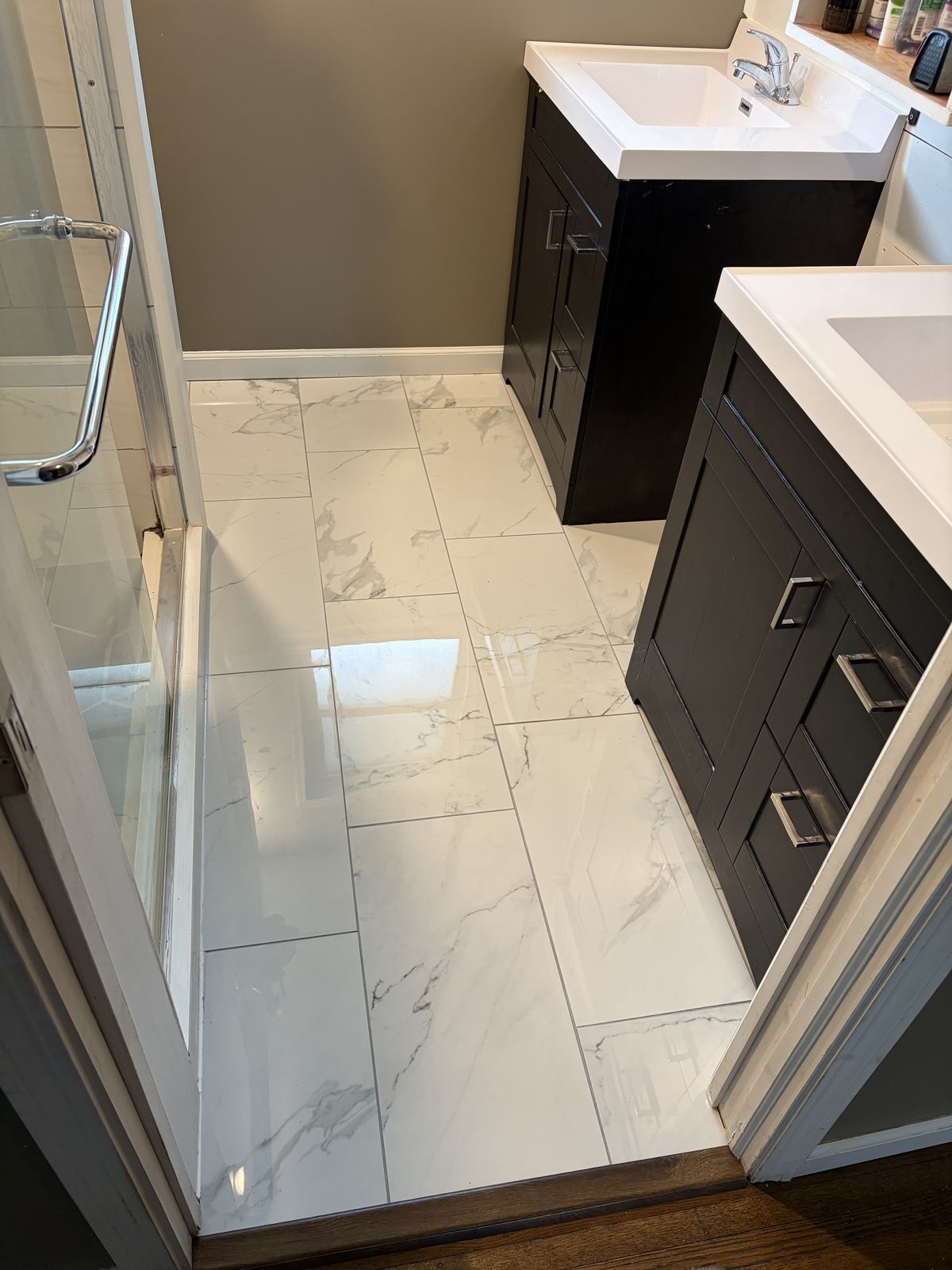
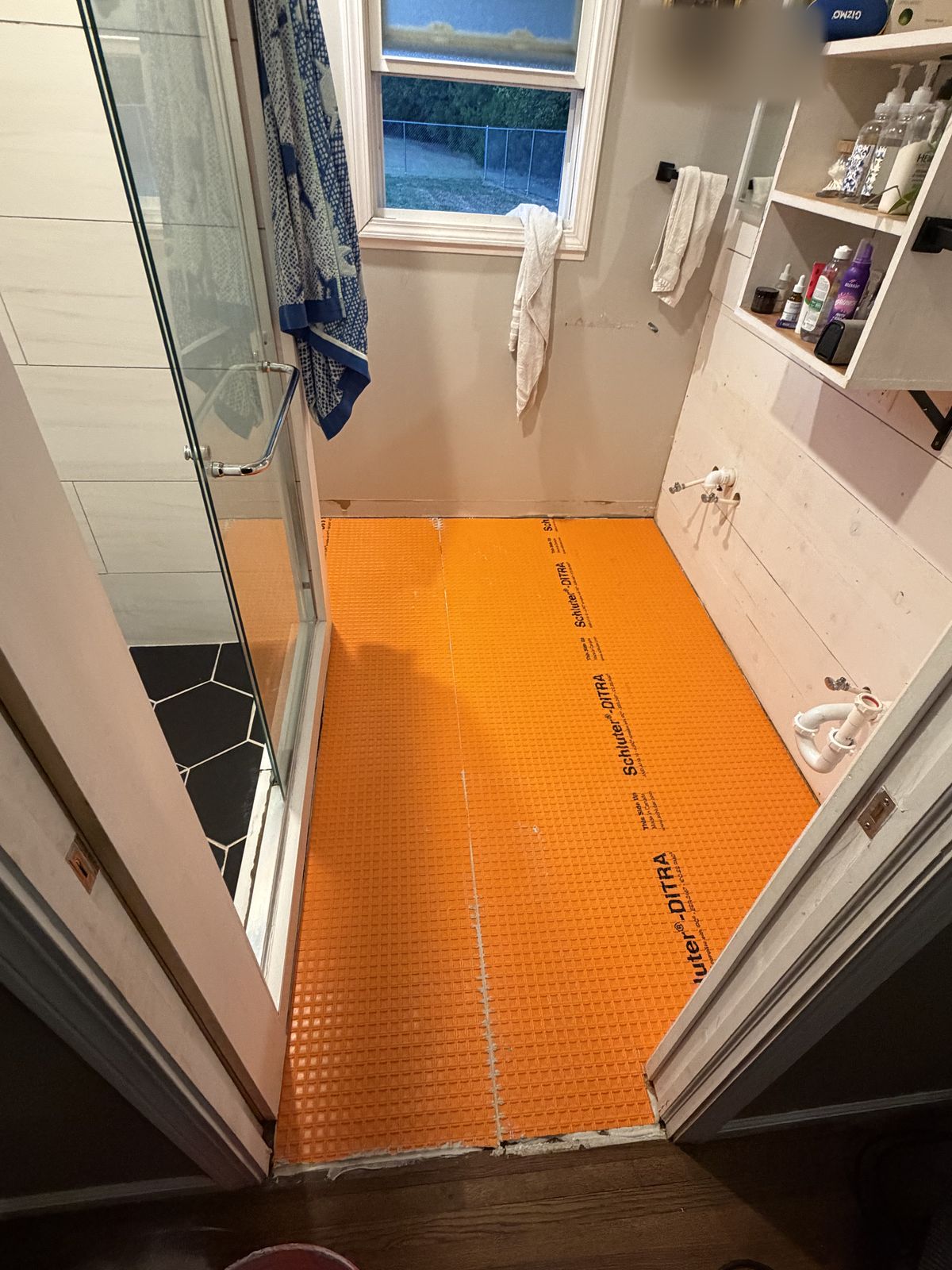
The finished floor, and Ditra laid over the original subfloor, from the Bel Aire project.
Thin-Set: The Detail That Trips People Up
The wrong mortar is the most common mistake over a membrane, and the instructions are not the same on every page you will read.
- Under Ditra on plywood or OSB: Schluter's tip sheet and DIY Tile Guy both call for a latex-modified thin-set to bond the membrane to the wood.
- Over Ditra, under the tile: Schluter's FAQ says to use Schluter SET, ALL-SET, FAST-SET, or an unmodified mortar that meets ANSI A118.1 for ceramic, porcelain, and stone. It says a modified mortar generally is not recommended there because it has to air-dry, and under porcelain it can take two weeks to two months or more to cure.
- Under cement board: a standard thin-set to bond the board, and a premium mortar to set large-format tile on it.
The takeaway is simple. The mortar is chosen for each layer, and you read the maker's current instructions before you open a bag.
Joists, Subfloor, and Floor Height
Ditra's standard version is rated for single-layer plywood or OSB over joists up to 19.2 inches on center, and DITRA-XL goes to 24 inches. Cement board has its own limits. Over a plank (board) subfloor, DIY Tile Guy says the planks need to be at least 3/4 inch thick, in good condition, and tongue-and-groove, and the usual route adds plywood over them before the membrane or board goes on. Schluter does not recommend Ditra over existing hardwood, which it calls unstable, and it lists limits for vinyl: not cushioned, not perimeter-bonded, and not more than one layer.
Height matters at the door. A membrane or board plus tile can sit higher than the floor in the hall, and that has to be handled with a transition. On our Bel Aire floor the tile meets the wood floor outside the bathroom at a threshold strip, which you can see in the finished photo on the project page.
When Ditra Is the Wrong Choice, and When Cement Board Makes Sense
- Small mosaic tile. Ditra is not meant for tile smaller than 2x2 inches. Cement board is the usual answer for penny rounds.
- Walls. Ditra is a floor product. Shower walls use other products.
- A tight budget and a stiff, flat subfloor. Cement board costs less and does the job when the subfloor is solid.
- Existing hardwood or cushioned vinyl. Schluter does not recommend a membrane over those, so they come out first.
Wichita and Kansas Factors
Slabs and soil movement. The Kansas Geological Survey notes that some Kansas soils contain clays that shrink and swell with wetting and drying. If your bathroom floor is a slab, a membrane can take up small movement between the slab and the tile, but it cannot fix a slab that is actively moving. Find out why it is moving first. The USDA Web Soil Survey shows the soil series at your address.
Weather swings. Wichita-area weather changes abruptly and often, according to the Kansas Geological Survey, and wood framing takes on and releases moisture with it. That kind of movement is what Schluter designed an uncoupling layer to take up.
Transitions to existing floors. Bathroom tile usually meets a different floor at the door, as it does on our Bel Aire job, so the height of the layer under the tile matters there.
We will tell you which layer fits your floor
TC Carpentry & Construction picks the layer under your tile after looking at your subfloor, your joists, your tile size, and the doorway heights. We use Ditra when the floor calls for it, as we did in Bel Aire, and we say so when it does not.
Ditra vs Cement Board FAQs
Is Ditra better than cement board for a bathroom floor?
Neither wins every time. Ditra uncouples the tile from the subfloor, is lighter and thinner, and can be sealed into a waterproof layer, but it costs more. Cement board costs less and is the traditional choice on a stiff, stable subfloor, but it is only water-resistant. On a wood bathroom floor with 12x24 porcelain tile we used Ditra.
Can I put Ditra over plywood in a bathroom?
Yes. Schluter lists single-layer plywood or OSB subfloors, with DITRA rated for joists up to 19.2 inches on center and DITRA-XL up to 24 inches. The membrane is bonded to the wood with thin-set, and the subfloor has to be sound and flat first.
Do I need to seal Ditra's seams in a bathroom?
If you want it to act as a waterproof layer, yes. Schluter says DITRA is waterproof for interior use when the seams and wall junctions are sealed with KERDI-BAND set in thin-set. A membrane laid without sealed seams should not be counted as waterproof.
Can I use modified thin-set over Ditra?
Schluter's FAQ says to use SET, ALL-SET, FAST-SET, or an unmodified mortar that meets ANSI A118.1 over DITRA for ceramic and porcelain, and says modified mortars generally are not recommended there because they have to air-dry. Check Schluter's current instructions for the exact product before you buy mortar.
Can Ditra go over existing vinyl or hardwood?
Schluter says DITRA can go over some existing vinyl, but not cushioned vinyl, perimeter-bonded vinyl, or more than one layer. It does not recommend it over hardwood. On our Bel Aire job we pulled the vinyl plank out instead of building on it.
Sources
Facts in this guide come from these pages. Checked November 2026. Product instructions and warranties from the maker govern any specific job.
- Schluter: DITRA and DITRA-XL product page
- Schluter FAQ: thin-set mortar type over DITRA
- Schluter FAQ: Is DITRA waterproof?
- Schluter FAQ: DITRA over vinyl flooring
- Schluter FAQ: DITRA over hardwood flooring
- Schluter: DITRA tip sheet
- DIY Tile Guy: Cement board vs Ditra (2022)
- DIY Tile Guy: Tiling over a wood plank subfloor
- Pro Builder: How uncoupling membranes for tile floors work
- Kansas Geological Survey: Using Soils of Kansas for Waste Disposal, Classification
- Kansas Geological Survey: Geohydrology of Sedgwick County, Geography
- USDA NRCS: Web Soil Survey
Not sure which one your bathroom floor needs?
The right layer under your tile depends on your subfloor, your joists, your tile, and the door heights around the room. Schedule a free consultation and TC Carpentry & Construction will check them and give you an itemized budget.