How to Choose Bathroom Floor Tile in Wichita, KS
Quick answer
For a bathroom floor, choose porcelain with a water absorption of 0.5 percent or less and a tested wet slip rating (DCOF) of at least 0.42. A 12x24 tile counts as large format, so the subfloor must be flat to 1/8 inch in 10 feet and the mortar must cover 95 percent of the tile in a wet area.
Porcelain vs Ceramic for a Bathroom Floor
Both are fired clay tile, and the difference that matters on a bathroom floor is how much water the tile absorbs. Manufacturer spec sheets list porcelain at 0.5 percent absorption or less, tested under ASTM C373. Ceramic tile is more porous. Porcelain is the usual choice for a bathroom floor, and ceramic is more common on walls.
| Porcelain | Ceramic | |
|---|---|---|
| Water absorption | 0.5 percent or less | Higher than porcelain |
| Where it fits | Bathroom floors and showers are the usual use | Often used on walls. Confirm it is rated for floors before you put it underfoot. |
| What to check | A tested wet slip rating for the exact finish | That the tile is rated for floors at all |
Matte vs Polished: Check the Slip Rating
Bathroom floors get wet. Tile makers publish a wet coefficient of friction (DCOF), and for level interior floors that will be walked on wet, the commonly cited figure under ANSI A137.1 is 0.42 or higher. Manufacturers say that number depends on the exact product and finish, so a polished version of a tile can test differently from the matte one. Ask for the tested number for the exact tile you are buying, not the series.
12x24 vs 12x12 vs Mosaics: Size Changes the Prep
Bigger tile looks cleaner with fewer grout lines, and it asks more of the floor. TileLetter describes tile with an edge over 15 inches as large format under the ANSI A108.02 flatness rule. A 12x24 has a 24 inch edge, so it counts.
| 12x12 and smaller | 12x24 (large format) | Mosaics | |
|---|---|---|---|
| Flatness of the subfloor | About 1/4 inch in 10 feet | No more than 1/8 inch in 10 feet, and no more than 1/16 inch in 24 inches | Follow the setting-material maker. Small tile still needs a flat, sound floor. |
| Mortar coverage | At least 80 percent in most applications | 95 percent in wet areas | Follow the setting-material maker |
| Under a Schluter Ditra membrane | Fine | Fine | Tile under 2x2 inches needs special consideration |
Flatness and coverage figures come from TileLetter's June 2025 article summarizing ANSI A108.02. Check the current standard and the tile maker's instructions for your tile.
That tighter flatness is why large tile sometimes means leveling or patching the floor first, and why we look at the subfloor before we quote. See how to tell if your bathroom subfloor is water damaged and Ditra vs cement board for what goes underneath.
Rectified vs Standard Edges
Rectified tile is cut square after firing, which allows a tighter joint and a cleaner look. It also shows lippage, the small height difference between neighbors, more plainly. TileLetter lists the maximum edge warpage allowed for porcelain under ANSI A137.1: 1.8 millimeters in general, and 1.3 millimeters for rectified tile 24 inches or smaller. The same article says flat floors matter even more when tiles are set in an offset pattern, and that narrow joints are risky, so follow the tile maker's minimum joint width.
What We Used in a Bel Aire Bathroom
On our Bel Aire bathroom we set 12x24 porcelain tile over a Schluter Ditra membrane, grouted it, reinstalled the toilet and both vanities, and finished with base trim and paint, all in three days. The tiles run in an offset pattern across the floor. The project page has the full scope and timeline.
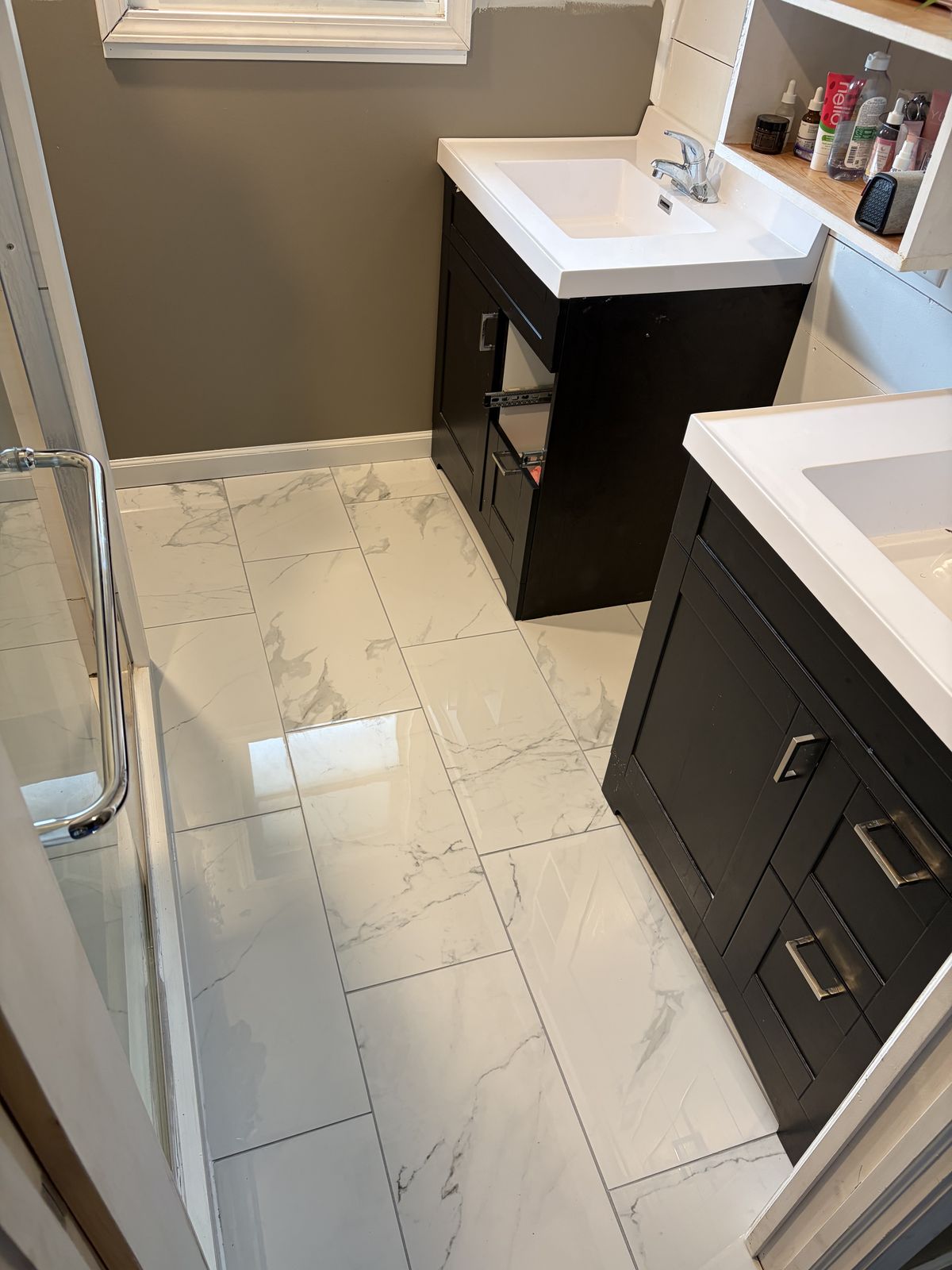
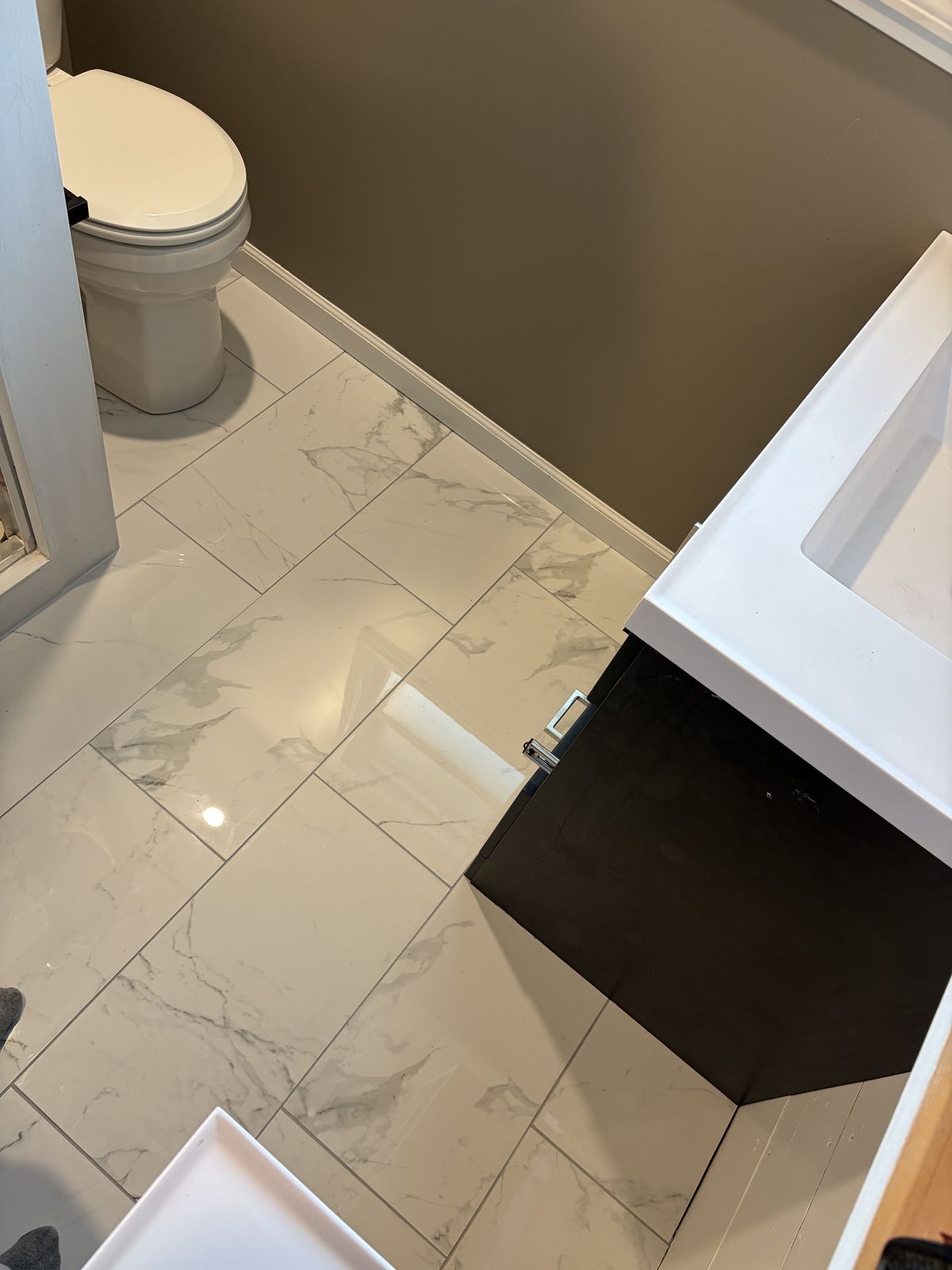
Finished 12x24 porcelain floor with base trim, from the Bel Aire project. Trim is part of our finish carpentry work.
Cement Grout vs Epoxy Grout
| Cement grout | Epoxy grout | |
|---|---|---|
| Water and stains | Porous, so it absorbs liquids, oils, and stains unless sealed | Non-porous and stain-resistant |
| Sealing | Needs a sealer and periodic resealing | Does not need sealing, according to Rubi |
| Cost | Less | More up front |
| Installing it | Forgiving | Hardens quickly and is harder to work with. The maker, Rubi, says the limited working time is its biggest drawback. |
Rubi is a tile-tool maker that favors epoxy. Read both sides, and ask your installer which grout they set well.
Wichita and Kansas Factors
Hard water and grout
City of Wichita reports have listed the average hardness of tap water around 7.7 to 7.8 grains per gallon, about 134 milligrams per liter. By the U.S. Geological Survey's scale, 121 to 180 milligrams per liter counts as hard water. Those were archived reports and the blend can change, so check the city's latest water quality report. Hard water leaves mineral film on tile and grout, and porous cement grout soaks up what it touches. That is a point in favor of sealing cement grout on schedule, or choosing epoxy.
Floors that are not flat
The median home in Wichita dates to 1974 and in Bel Aire to 1995, according to City-Stats and 2023 Census survey figures. Floors that old have settled, been patched, and carried older flooring. Large tile makes every dip show, so expect a flatness check before 12x24 goes down.
Permits for tile
MABCD says tile can be replaced without a permit when it was already there. If the job moves a fixture, Bel Aire's published list says adding or moving plumbing fixtures needs a permit. See our remodeling permits guide.
Bring your tile, we will check the floor
TC Carpentry & Construction is a licensed and insured general contractor, and bathroom tile is part of our bathroom remodeling. Send us the tile you are considering and we will tell you what it needs under it, how long it takes, and what it costs.
Bathroom Floor Tile FAQs
What is the best tile for a bathroom floor?
Porcelain with a water absorption of 0.5 percent or less and a tested wet slip rating (DCOF) of at least 0.42 for the exact finish is the usual choice. Check the number for the exact tile you buy, because finishes in the same series can test differently.
Can I use 12x24 tile in a small bathroom?
Yes, but 12x24 counts as large format, so the subfloor has to be flat to 1/8 inch in 10 feet and 1/16 inch in 24 inches, and the mortar has to cover 95 percent of the tile in a wet area. Many floors need leveling or patching first. We set 12x24 porcelain in a Bel Aire bathroom in three days.
Is epoxy grout worth it on a bathroom floor?
Epoxy is non-porous and does not need sealing, which helps with stains and hard water, but it costs more and is harder to install because it hardens quickly. Cement grout costs less and works well when it is sealed and resealed on schedule.
Do I need to seal grout in a bathroom?
Cement grout does. It is porous and takes in water, oils, and mineral deposits unless it is sealed, and it needs periodic resealing. Epoxy grout does not need a sealer. Wichita's tap water has been reported as hard, which is one more reason to keep grout sealed.
How flat does a floor need to be for large tile?
For tile with an edge over 15 inches, the standard allows no more than 1/8 inch of variation in 10 feet and no more than 1/16 inch in 24 inches. Smaller tile is held to about 1/4 inch in 10 feet. A flatness check before tiling shows whether the floor needs work.
Sources
Facts in this guide come from these pages. Checked November 2026. Product instructions and warranties from the maker govern any specific job.
- TileLetter: Large format tile, know your numbers (June 2025)
- Marazzi: example manufacturer spec for wet slip rating (DCOF)
- Portobello: example porcelain technical data sheet (absorption)
- Rubi: Epoxy grout (manufacturer, favors epoxy)
- Schluter FAQ: thin-set mortar type over DITRA
- City of Wichita: archived water quality information (hardness)
- U.S. Geological Survey: Hardness of water
- MABCD: Do I Need a Permit?
- City of Bel Aire: Building Permits
- City-Stats: Wichita housing (median year built, ACS 2023)
- City-Stats: Bel Aire housing (median year built, ACS 2023)
Picking tile for your bathroom floor?
Bring your tile samples or your questions. TC Carpentry & Construction will tell you what your floor needs underneath, what the tile and grout you like will take to install, and what it costs, with a free consultation.